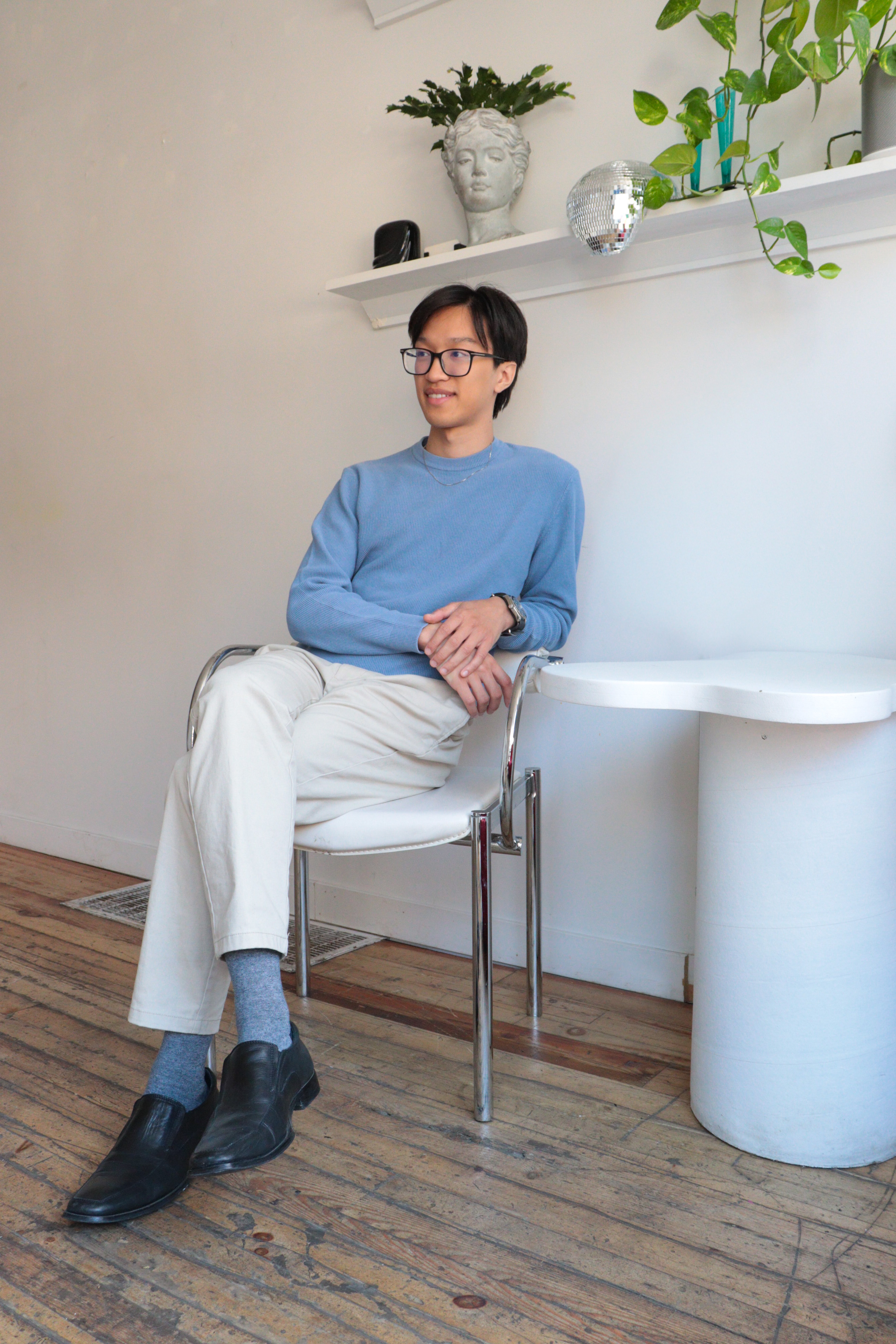
Lewis Ba Luc Le, Registered Psychotherapist (Qualifying)
My journey

How I got here

I started with relationships: who you are, who the other person is, what happens in the space between. From there, the lens kept widening: family, community, the full range of what people are capable of at their best and worst. What I found, eventually, was that all of it translated into something practical. A way of reading situations that had become instinct, backed by both emotional and intellectual grounding.

What drew me to this work, specifically, was a pattern I kept encountering: people in pain that didn't have a name yet. Loneliness. Self-isolation. A loss of self so gradual they couldn't point to where it started. The more I understood those patterns, the more my curiosity took over. Eventually, recognising them became second nature. Navigating people away from them became the work.

My work has taken me across communities I didn't grow up in. I've worked with LGBTQ+ individuals, with Black and Asian families, with people carrying inherited trauma they didn't have a name for. What showed up consistently was that the tools most people had been given weren't built for their actual lives. That's the gap I work in.

I'm Vietnamese-Canadian. I grew up navigating two different versions of what a good life looks like, and doing a lot of translation work that nobody counted as work. That experience is in the room with me when I sit with clients who are doing the same thing.

I also have ADHD. I grew up without anyone recognising it at all. By the time I understood what was happening, I had years of evidence that I was somehow just not trying hard enough. That history changes what it means to sit across from someone in the same position.

I love watching people get closer to a place they want to be. I see people at their worst sometimes, and it is an honour to celebrate what the world offers while giving real time to what's hard. That's the work. I haven't found a better one.

The only thing that changes between work and outside of it is pace. In session, I'm more deliberate in how I speak and how much space I hold for someone to think. Outside of it, I'm the same person. Same personality. Same colour. It's not a performance. Authenticity doesn't require putting on a different version of yourself.

  • Background in psychology and relationships, expanded into family, community, and behaviour over time.
  • Drawn to people experiencing unnamed pain: loneliness, self-isolation, a gradual loss of self.
  • The tools most people were given weren't built for their actual lives. That's the gap he works in.
  • Vietnamese-Canadian. Grew up doing translation work between two cultures. That experience comes into the room.
  • Has ADHD. Grew up without it being recognised. Spent years thinking he wasn't trying hard enough. That history changes what it means to sit across from someone in the same position.
  • Outside sessions: same personality, same person. No performance. Authenticity isn't a different version of yourself.
Personality & social psychology Registered Psychotherapist (Qualifying) Vietnamese-Canadian ADHD Cultural identity LGBTQ+ experience
Who I work best with

The people I tend to be most useful for

I work best with people who are not confident in who they are, people who feel like they've lost parts of themselves somewhere along the way, through trauma, through years of performing what was expected of them, or through just not having had the space to figure it out yet.

That includes people newly diagnosed with ADHD who are reframing their entire history. People from Vietnamese or broader Asian backgrounds who have spent their lives translating between two worlds. People navigating LGBTQ+ identity inside families or communities that make that harder.

What they tend to have in common: they're carrying more than they've said out loud, and they're ready to actually look at it.

  • Best suited for people who feel they've lost parts of themselves, through trauma, performance, or not having had space to figure it out.
  • Includes: newly-diagnosed ADHD, Vietnamese/Asian backgrounds living between two worlds, LGBTQ+ identity in unsupportive contexts.
  • Common thread: carrying more than they've said out loud, and ready to actually look at it.

I'm probably not the right fit if...

You're looking for structured, session-by-session homework with clear milestones and a defined end date from week one.

My work is integrative and tends to be longer-term. I work at the level of understanding, which is slower, and also more durable.

If you want a specific, structured protocol for a specific presenting issue, I'm happy to recommend someone who works that way. The free call is the right place to figure that out.

One more thing worth saying: if I don't think I'm the best person for what you're dealing with, I'll tell you. I keep a network of clinicians who are excellent in particular niches. If someone in that network is better placed to help you, I'll say so and make the introduction. Your fit with the right practitioner matters more than me filling a slot.

Credentials & Training

What I have

Lewis Ba Luc Le is a Registered Psychotherapist (Qualifying), a designation with the College of Registered Psychotherapists of Ontario (CRPO) that allows for the practice of psychotherapy under clinical supervision.

Registered Psychotherapist (Qualifying), CRPO

Registered with the College of Registered Psychotherapists of Ontario. Eligible to practise psychotherapy under supervision. Registration #20334 (registered 19 August 2025).

Master of Arts in Counselling Psychology

Yorkville University, 2026

Approach

Integrative, relational, and insight-oriented. I draw from Psychodynamic therapy, Cognitive Behavioural Therapy (CBT), Dialectical Behaviour Therapy (DBT), Acceptance and Commitment Therapy (ACT), Narrative Therapy, and Mindfulness-Based approaches. The specific tools depend on what you're working on. I reach for what's actually useful to you.

Supervised practice

As a Registered Psychotherapist (Qualifying), Lewis practises under clinical supervision as required by the CRPO. This is a standard part of the qualifying pathway and is a condition of registration.

A note on the (Qualifying) designation

It means I've completed all the schooling required to practise as a psychotherapist and I'm now in the final stage of licensure. I am legally allowed to practise. I meet regularly with a senior clinical supervisor to make sure the care I'm providing is effective, safe, and current.

That supervision isn't a sign of limitation. It means my knowledge and perspective are still being actively updated. If you have questions, ask in the first call.

Practical details

Fees & how sessions work

Session fees

$150 / 50 min: Individual

$200 / 50 min: Couples & Families

Extended sessions (80 min) available. Fees: $200.

Many extended health insurance plans cover services from a Registered Psychotherapist. Check your benefits provider directly. Coverage varies by plan.

Sliding scale: A limited number of sliding scale spots are available.

Format & booking

All sessions are online, via Jane App. Toronto, Ontario.

Sessions are 50 minutes. Frequency varies: some people come weekly, some bi-weekly, some monthly. We figure that out based on what you're working on.

Most clients work with me for 3–6 months on a consistent basis, though some touch in occasionally over longer periods.

Psychology Today Profile →
How I work

What to expect in a session

We just met. I wouldn't go in depth with a stranger, and I don't ask that of clients either. The first few sessions are always about getting to know you: who you are, what's been going on, what's underneath that.

I ask questions designed to help you think, not to demonstrate that I already know the answer. The most useful thing I can do is help someone hear themselves more clearly.

One thing I notice consistently: people can't see their own patterns from inside them. Good habits and bad habits both become invisible when they're just daily life. Part of what I bring to the room is an outside perspective that can see what's operating beneath the surface. You are both the creator of your current patterns and the embodiment of ones you learned long before you were making deliberate choices about who to be. Seeing that clearly is usually where the useful work starts.

I'll also say this: the one thing I'll never fully know is you. The more we talk, the more I learn. That gap between wanting to understand someone and actually understanding them can be as wide as the ocean. I don't pretend otherwise. That honesty is part of how I work.

What I work with

ADHD, especially late diagnosis and its implications Anxiety and the patterns underneath it Depression and what keeps it in place Life transitions and adjustment Self-esteem and personal identity LGBTQ+ identity and experience Eastern Asian: Vietnamese and Asian immigrant experience Couples and family dynamics Relational patterns and communication Procrastination and executive function

Ready to start the conversation?

The first call is free, 20 minutes to talk through what's going on and figure out whether working together makes sense for both of us.

Book a Free 20-Min Call